
What is a Construction Allowance, Like Really?
What Does a Construction Allowance Actually Mean?
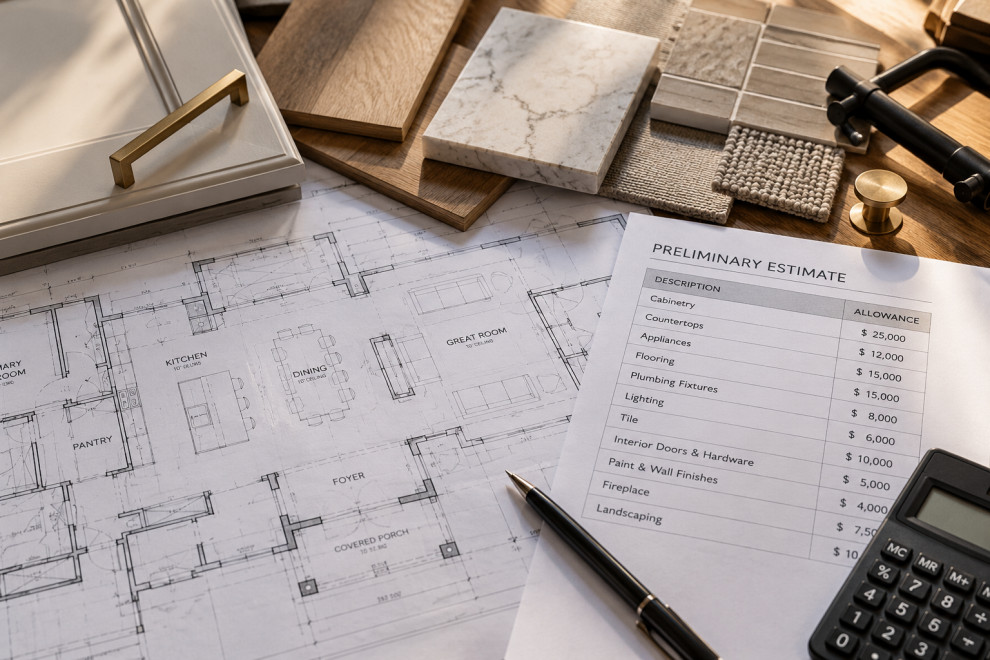
There's a lot of jargon used in my industry that can get confusing and/or overwhelming. If you've ever looked through a construction estimate, you've probably seen "allowances" listed for things like cabinets, flooring, appliances, or plumbing fixtures. Most people understand that an allowance is money set aside for something that hasn't been selected yet, but what isn't always clear is how that number was established, what it means and includes, and what happens when the actual cost is different.
Allowances are one of the more misunderstood parts of construction pricing, and they're something I pay particular attention to when creating budgets and estimates.
There's nothing necessarily wrong with using them--in fact, they're often useful. But they can also make two estimates for the exact same project look considerably different, even when the actual cost to build it may end up being about the same.
What's in the number?
Let's say we're putting together a budget for a custom home, and you haven't made your cabinet selections yet. We might carry a $25,000 allowance for cabinetry, meaning we're assuming that value in the overall project budget for something we haven't fully priced. It doesn't mean the cabinets will cost exactly $25,000, and it certainly doesn't mean you can select anything you want without affecting the price. Basically, if your final cabinet package comes in at $30,000, we're $5,000 over the allowance. If it comes in at $22,000, we're $3,000 under.
How those differences are handled should be spelled out in the construction agreement ("Know Your Contract" is another upcoming blog). Simple enough, right? Where it gets a little more complicated is figuring out what that original $25,000 was supposed to cover--are we talking about cabinets for the kitchen only, or the entire house? Does it include installation, hardware, delivery, and taxes? What about bathroom vanities or laundry room cabinets?
I've seen allowances that cover materials only and others that include a complete installed scope. If you don't know which you're looking at, that number doesn't tell you very much.
Two Estimates, Two Very Different Assumptions
Here's an example: you're getting estimates from two builders for the same custom home. One carries $30,000 for cabinets, $15,000 for flooring, and $8,000 for plumbing fixtures. Builder #2 other carries $18,000 for cabinets, $9,000 for flooring, and $4,000 for plumbing fixtures. That's a $22,000 difference before we even get into the actual construction. Now, maybe the second builder has a better supplier relationship or a different approach to the work...that's entirely possible. But maybe they're just assuming you're going to select less expensive finishes. So, which is it?
If you ultimately choose the same cabinets, flooring, and fixtures regardless of which builder you hire, that $22,000 difference may disappear. Depending on how the contracts are structured, it could end up costing even more.
That's why I wouldn't put much stock in comparing the bottom line of two estimates until I've looked at what's actually included. A lower estimate isn't necessarily a better estimate. And to be fair, a higher estimate isn't automatically more complete or accurate, either.
You have to look at the details.
Where Allowances Can Become a Problem
I don't have an issue with allowances... in fact, I use them in every estimate. I do take issue with allowances that aren't realistic.
If we're discussing a custom home with a large kitchen, custom cabinetry, and high-end appliances, there's no reason to carry a budget that assumes builder-grade finishes unless that's what the client actually wants--I've lost competing bids because of this, only to learn later that the winning contractor well over-spent that phase. Sure, it makes the initial estimate look better. But what have we accomplished?
Eventually, the client is going to make selections, and the actual numbers are going to replace those allowances. If we've carried unrealistic amounts, we're going to spend a lot of time explaining why the project is suddenly over budget. I'd rather have that conversation during pre-construction, when we can still make adjustments without disrupting the work, and I also think the number of allowances matters.
It's perfectly reasonable to have a few selections outstanding when a construction agreement is signed. But if a significant portion of the project is still being carried as allowances, I'd want to understand how much confidence we really have in the contract price.
What Happens When You Go Over an Allowance?
Let's go back to the cabinetry example: we've carried $25,000 in the estimate, and the final approved cost comes in at $32,000, making a $7,000 difference.
Depending on the construction agreement, there may also be applicable contractor markup or other costs associated with that adjustment. The same goes in reverse. If the final cost is less than the allowance, the unused amount should be reconciled according to the agreement.
This is something I think homeowners should understand before signing anything. How are allowances tracked? Who approves the final selections? Is markup applied to overages? How are credits handled?
These aren't details you want to figure out after the cabinets have already been ordered and I get the googly eyes of budget despair.
And one other thing worth mentioning: an allowance overage isn't always the same as a change in scope. Selecting a more expensive faucet within an existing fixture allowance is different from deciding halfway through construction that you want to add another bathroom. The contract should address how each situation is handled.
Allowances and Contingency Aren't the Same Thing
I see these terms used interchangeably sometimes, but they're serving two different purposes. An allowance covers something we know we're going to need but haven't completely defined or selected. Contingency is money reserved for things we don't necessarily know we're going to encounter.
On a renovation, for example, we might carry an allowance for tile selections while also recommending contingency for unforeseen conditions behind existing walls or beneath the floor. These are different risks, and I prefer to keep them separate in the budget. It makes it easier for everyone to understand where the money is going and what remains available.
How I Prefer to Build a Budget
My preference is to work through as many of the major selections as we reasonably can before construction begins. That doesn't mean every light fixture, door handle, and paint color has to be selected on day one. But we should have a pretty good understanding of the quality level and scope we're trying to achieve.
If we haven't selected the cabinets, I want an allowance based on the kitchen we're actually designing, not a generic number pulled from another project.
If we're carrying flooring, I want to understand the type of flooring, approximate quantities, and whether we're including installation and related materials. The more information we have, the less we're guessing.
I also like to get subcontractor and supplier input early, particularly on larger or more complicated scopes. A preliminary quote based on actual drawings and specifications is generally more useful than a placeholder number.
As the project develops, we should be replacing assumptions with real pricing--that's a big part of what pre-construction is supposed to accomplish.
What I'd Look for When Comparing Estimates
If I were hiring a builder, I'd want to understand a few things before signing a contract.
First, I'd ask for a clear breakdown of the allowances. Not just the amounts, but what each one covers.
Second, I'd want to know how those numbers were developed. Were they based on actual supplier pricing, previous projects, preliminary selections, or simply a budget target?
Third, I'd ask how differences are handled once selections are finalized. That includes overages, credits, applicable markup, and approval requirements.
And finally, I'd look at the overall estimate to see how much of the project is actually priced versus how much is still an assumption.
I wouldn't expect every detail to be finalized on day one, but I would expect the builder to be able to explain the numbers.
My Take?
I think allowances are a perfectly reasonable part of construction budgeting when they're used correctly. They give us a way to move a project forward while some decisions are still being made. But they need to be realistic, clearly defined, and understood by everyone involved.
The problem isn't having an allowance in your estimate. It's finding out halfway through construction that the allowance never reflected what you intended to buy.
When I'm developing a budget at Lakewood Custom Builders, I'm not particularly interested in making the initial number look as low as possible. I'd rather establish a realistic budget, explain where the assumptions are, and work through those decisions before they become expensive problems.
That's not to say every project is going to finish exactly on the original budget. Construction doesn't work that way, particularly when you're renovating an existing home.
But there's a big difference between an unforeseen condition and a cost increase we could have reasonably anticipated from the beginning.
If you're comparing estimates, don't just ask which builder has the lowest price. Make sure you understand what each builder has actually priced.
That's usually where the more useful conversation begins.
At Lakewood Custom Builders, we work with homeowners throughout Central Virginia on custom homes, additions, and renovations. If you're considering a project and want to better understand how construction budgets are developed, we're happy to discuss the process and what you should expect before getting started.