How Long Does it Take To Build a Custom Home in Central Virginia?
One of the first questions I get when talking with someone about building a custom home is pretty simple:
“How long is this actually going to take?”
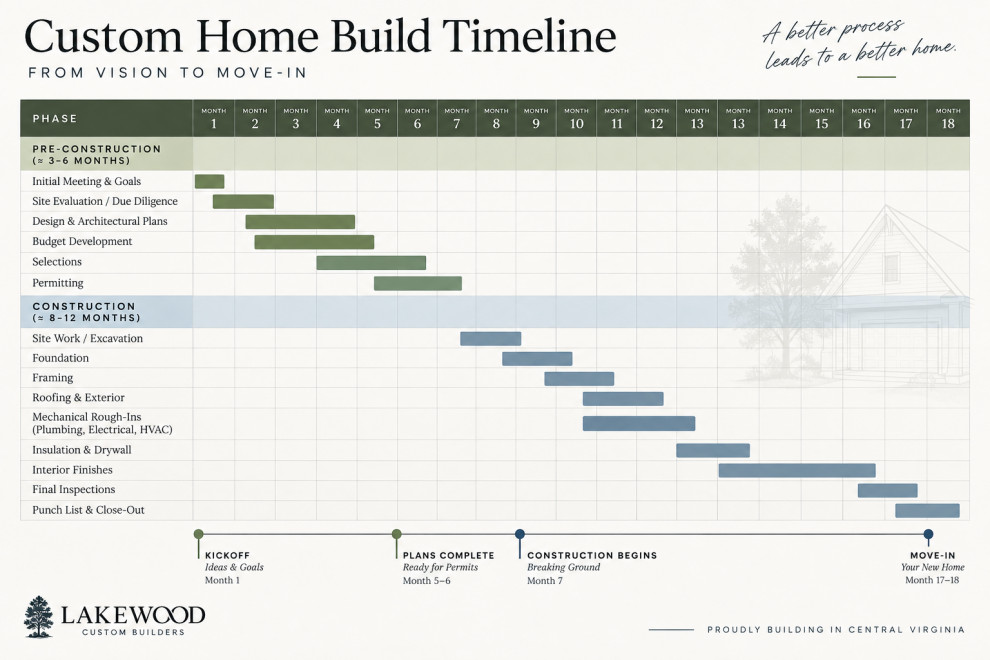
This is a a great and important question and one of the 'big three' I often get--this one (being about time), and the other about budget and the third being quality. My general answer is to plan on about 12 to 18 months from the time we really get started until you're moving into the house. There's a LOT to consider.
Could it be faster? Absolutely.
Could it take longer? 100%.
There are a lot of variables, but I think 12–18 months is a reasonable expectation when you're talking about the entire process, not just the time we're physically building the house. And that's an important distinction.
There's a Lot That Happens Before We Break Ground
When people picture building a house, they usually picture excavation equipment showing up and the foundation going in. There's quite a bit of work that has to happen before we get there. Depending on where you are in the process, we may need to deal with:
- Surveying
- Soil and septic work
- Site planning
- Architectural plans
- Engineering
- Selections
- Budgeting
- Financing
- Permitting
- Utility coordination
Some clients come to me with land, completed plans, and financing already lined up. Super, that's a great start for sure.
Others call and say, “We have a piece of land and an idea of what we want.”
Both are perfectly fine. They're just starting at very different places on the timeline.
For someone starting near the beginning, however, I'd allow at least 3–6 months for pre-construction, and sometimes more.
Personally, I don't think that's an area worth rushing. I'd rather spend another month getting the plans, budget, site, and major decisions figured out than save a month up front and spend the next year solving problems in the field.
Once We Start Building
For the actual construction of the house, 6–12 months is a reasonable planning range for many of the custom homes we're talking about in Central Virginia.
But I wouldn't put that number in a contract without knowing what we're building. A straightforward 2,500-square-foot crawlspace home on a relatively easy site is a very different project from a 5,000-square-foot custom basement home on a wooded piece of property with a long driveway, well, septic, extensive sitework, and high-end finishes.
And surprisingly, square footage isn't always the biggest factor--the complexity matters.
Another example could be a smaller house with complicated rooflines, custom millwork, specialty finishes, and a lot of unique details can take longer than a larger house with a relatively straightforward design.
What Actually Slows a Project Down?
Everybody immediately thinks weather--and yes, weather matters. We're building outside. A week of rain at the wrong point in the project can absolutely affect the schedule--a few years back I documented 26 of 28 days with a rain event in February. Not great.
One of the bigger schedule killers is actually decisions that haven't been made when we need them. Windows, doors, cabinets, appliances, plumbing fixtures, lighting, tile—you don't necessarily walk into a store on Tuesday and have these things sitting on the jobsite Wednesday. Indecision has absolutely poopooed progress on projects in the past, and some of these items have significant lead times.
That's why I'm a big believer in making as many decisions as we reasonably can before they're needed. If the electrician is ready and we're still deciding where lights should go, we're losing time. If the cabinet installer is ready but the cabinets won't arrive for another six weeks, we're losing time.
A good schedule isn't just about working fast. It's about having the next decision, material, and trade ready when we need them.
“Can You Build It Faster?”
Probably, but I don't think that's always the right goal.
If someone tells me they absolutely need to be in the house in six months, my first reaction isn't going to be to promise that we can make it happen.
I'm going to want to know why.
There are certain parts of construction you can make more efficient. There are other parts that simply take the time they take. Concrete needs cure time, inspections have to happen, materials have lead times, trades need to work in the right sequence.
I'm much more interested in running an efficient project than bragging about how quickly we can build a house. I've seen projects (like mine, naturally) that have a clear and concise plan, allowing subs in the house/project be more efficient than one that has an ant farm of daily activity. It's hard to be efficient when you got guys on top of each other all the time. It may look great, but it's detrimental to progress.
At the end-of the day, if you turn the time up, it will affect the aforementioned budget and quality. I'd rather take the needed time to deliver a high-quality product than to squeeze in the help at the risk of this.
Changes During Construction Matter Too
This is another one people don't always think about: Changing something on paper is easy, changing it after we've built it isn't.
If we're framing and you decide you'd really like that window moved six feet, we can probably do it, sure. But now we may be changing framing, electrical, siding, drywall, trim, and possibly something else that was designed around that window.
One change can have a ripple effect.
I expect there will be some changes during any custom project--that's part of building something specifically for one client. But the more we can work through during design and pre-construction, the better the construction schedule is going to be.
So When Should You Start?
Earlier than you probably think. If you want to be living in your new home sometime next year, I wouldn't wait until next year to call a builder. And, no, you don't need to have everything figured out before you make that call. Honestly, I'd rather talk to someone too early than too late.
If you own the land but don't have plans yet, that's fine. If you're looking at land but haven't bought it yet, that's fine too. If you have a Pinterest board, a rough budget, and no idea what you're doing next—that's actually a pretty normal place to start. Part of my (our--thanks Meg) job is helping you figure out how to get from there to a finished house.
My Advice?
If you're thinking seriously about building a custom home in Central Virginia, give yourself 12–18 months for the overall process and don't get overly focused on the groundbreaking date. The work we do before breaking ground is often what determines how smoothly everything goes afterward.
I'd rather have a project start construction a month later with the right plans, realistic numbers, major selections made, and everyone on the same page than start a month earlier just so we can say we started.
The goal isn't to start building as quickly as possible--the goal is to finish with house you're happy with and a process that was managed well.
That's how I approach custom homes at Lakewood Custom Builders.
If you're thinking about building in Hanover, Goochland, New Kent, Chesterfield, or elsewhere in Central Virginia, feel free to reach out. Even if you're early in the process, I'm happy to talk through where you are and what the next few steps should look like.
Thanks, Adam